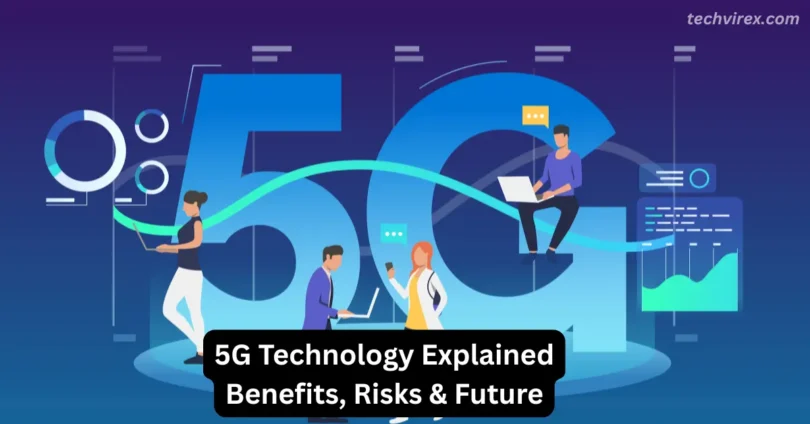

Technology never slows down, and when it comes to speed, 5G Technology is the biggest buzzword of the decade. If you think 5G is only about faster internet on your smartphone, think again. It is much bigger, smarter, and more powerful than that.
This article explains 5G Technology simply and humanly. We will explore 5G benefits, real-world 5G applications, potential risks, and the future of 5G—without turning it into a boring tech lecture.
What Is 5G Technology?
5G Technology stands for the fifth generation of mobile network technology. It is designed to deliver extremely fast data speeds, ultra-low latency, and the ability to connect millions of devices at the same time.
Unlike previous generations, 5G is not just about mobile phones. It is built to support smart cities, autonomous vehicles, remote healthcare, artificial intelligence, and the Internet of Things. In short, 5G is the foundation of a fully connected digital world.
You may like this
Autonomous AI Agents: How AI Is Replacing Human Jobs Faster Than Ever
Top 30 Best Free & Paid AI Tools Software Everyone Will Use
Best Laptops for Programming and Graphic Design
Top Smartwatches for Fitness and Health Tracking
How 5G Technology Works
5G Technology works by using higher-frequency radio waves along with advanced antennas and network infrastructure. These high-frequency signals carry data much faster than older networks, which results in instant response times.
Another important feature of 5G is network slicing. This allows the same network to be divided into virtual sections, each optimized for different uses such as gaming, healthcare, or industrial automation. This makes 5G faster, smarter, and more efficient.
Difference Between 4G and 5G Technology
The difference between 4G and 5G Technology is not just speed—it is capability.
4G networks were designed mainly for smartphones and video streaming. 5G networks are designed for machines, smart systems, and real-time communication. While 4G latency is measured in seconds, 5G latency is measured in milliseconds.
In simple terms, 4G connected people. 5G connects everything.
5G Benefits That Matter
One of the biggest reasons behind the global excitement around 5G Technology is its wide range of benefits. These advantages go far beyond faster downloads.
Faster Internet Speeds
With 5G benefits, internet speeds can be up to 100 times faster than 4G. This means downloading large files in seconds and streaming high-quality videos without buffering.
Ultra-Low Latency
Latency refers to the delay between sending and receiving data. With 5G, latency is almost unnoticeable. This is critical for online gaming, video calls, and real-time applications.
Massive Device Connectivity
5G Technology can connect millions of devices in a small area without slowing down. This makes it ideal for smart homes, smart cities, and IoT ecosystems.
Better Network Reliability
5G networks are more stable and reliable, even in crowded areas such as stadiums or public events. No more “network busy” messages at the worst possible time.
5G Applications in Real Life
The real power of 5G applications lies in how they change industries and daily life.
Healthcare and Telemedicine
Doctors can perform remote surgeries with real-time precision using 5G-powered robotic systems. Patients can also receive faster diagnoses through connected medical devices.
Smart Cities
Traffic management, energy systems, waste management, and public safety can all be optimized using 5G Technology. Smart cities rely heavily on fast and reliable connectivity.
Autonomous Vehicles
Self-driving cars need instant communication with roads, traffic signals, and other vehicles. The low latency of 5G makes autonomous transportation safer and more efficient.
Entertainment and Gaming
With 5G applications, cloud gaming, virtual reality, and augmented reality become smoother and more immersive. Lag becomes a thing of the past.
Role of 5G in Business and Industry
Businesses are adopting 5G Technology to increase productivity and efficiency. Factories use 5G-enabled automation to reduce errors and downtime. Retail stores use smart analytics to improve customer experience.
Remote work also benefits from 5G through stable video conferencing and faster data sharing. For businesses, 5G is not a luxury—it is a competitive advantage.
Risks and Concerns of 5G Technology
Despite its advantages, 5G Technology also raises some concerns that cannot be ignored.
One major concern is cybersecurity. With more connected devices, the risk of cyberattacks increases. Strong security measures are required to protect data and privacy.
Another concern is infrastructure cost. Building 5G networks requires significant investment, especially in developing countries. There are also public concerns about radiation, although scientific studies have not proven 5G to be harmful.
Is 5G Technology Safe?
According to global health organizations, 5G Technology operates within international safety guidelines. The radiation levels are similar to existing mobile networks and are considered safe for public use.
However, continuous research and regulation are necessary to maintain public trust and ensure long-term safety.
Future of 5G Technology
The future of 5G looks extremely promising. As adoption increases, new innovations will emerge across industries. Artificial intelligence, machine learning, and edge computing will become more powerful with 5G support.
In the coming years, 5G Technology will act as a bridge toward 6G, enabling even more advanced communication systems. The future will be faster, smarter, and more connected than ever before.
Why 5G Technology Is a Game Changer
What makes 5G Technology truly revolutionary is its ability to transform how humans and machines interact. From healthcare to entertainment, from education to transportation, 5G is reshaping the digital landscape.
It is not just an upgrade—it is a complete transformation of communication technology.
Read more
Best Smartphones: iPhone 17 vs Samsung Galaxy S26
Best Wireless Earbuds with Noise Cancellation Under $200
Best Smartphone Accessories: Must‑Have Gadgets, Chargers & Earbuds
FAQs About 5G Technology
What is 5G Technology used for?
5G Technology is used for high-speed internet, smart devices, autonomous vehicles, healthcare systems, and industrial automation. It supports real-time communication and massive device connectivity.
What are the main 5G benefits for users?
The main 5G benefits include faster speeds, lower latency, better connectivity, and improved network reliability for everyday and professional use.
Will 5G replace 4G completely?
5G will not immediately replace 4G. Both networks will coexist for several years, with 5G gradually becoming the dominant technology.
Is 5G Technology expensive?
Initially, 5G devices and infrastructure may be costly. However, prices are expected to decrease as adoption increases and technology matures.
What industries will benefit most from 5G applications?
Industries such as healthcare, transportation, manufacturing, gaming, and smart city development will benefit the most from 5G applications.
Conclusion
5G Technology is more than just faster internet—it is the backbone of the future digital world. With powerful 5G benefits, wide-ranging 5G applications, and a promising future of 5G, this technology is set to redefine how we live and work.
As the world becomes more connected, 5G will play a crucial role in shaping innovation, efficiency, and growth across every sector.