


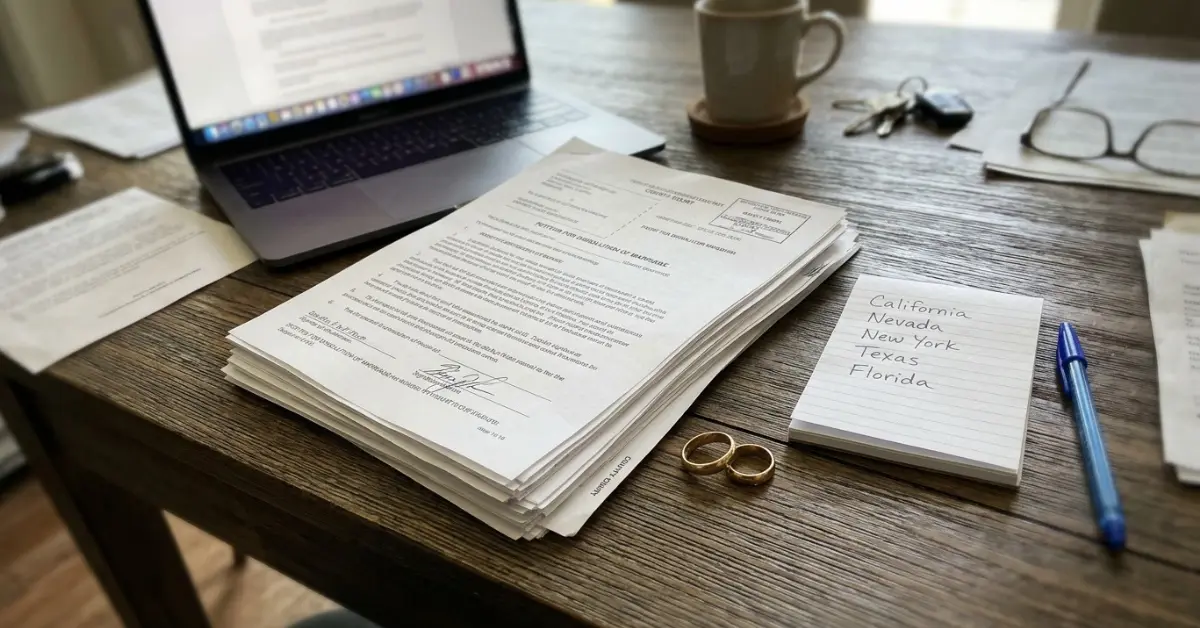
As of 2026, Colorado, Iowa, Kansas, Montana, Rhode Island, Texas, Utah (court process only) and Washington, D.C. recognize new common law marriages. Oklahoma recognizes them through court rulings, but its law is unsettled. Every other state requires a license and ceremony.
Where You Can Still Form One
| Place | Status | The catch |
|---|---|---|
| Colorado | Yes | No minimum time. Mutual intent matters most. |
| Iowa | Yes | Needs intent, shared home, and public reputation. |
| Kansas | Yes | Needs a present agreement and “holding out.” |
| Montana | Yes | You must live together in Montana. |
| Rhode Island | Yes | Case law. Proof must be clear and convincing. |
| Texas | Yes | Called “informal marriage.” Two-year rule applies. |
| Utah | Court-approved | A judge or agency must confirm it. |
| Washington, D.C. | Yes | Same core elements as other states. |
| Oklahoma | Unsettled | Statute needs a license, courts say otherwise. |
Montana Is Still Open
Several popular guides list Montana as closed. I checked this, and it is wrong. Montana’s Supreme Court confirmed common law marriage again in 2025.
One of those rulings found a couple married even though they had ticked “single” on official forms. Another refused to count a relationship that never involved living together in Montana.
States That Closed the Door (Legacy Only)
These states honor only marriages formed before a cutoff date:
- Pennsylvania: before January 1, 2005.
- Alabama: before January 1, 2017.
- South Carolina: before July 24, 2019.
- Georgia: before January 1, 1997.
- Idaho: before January 1, 1996.
- Ohio: before October 10, 1991.
- Florida: before January 1, 1968.
New Hampshire is a special case. It treats a couple as married only for inheritance, after one partner dies.
What Happens When You Move
A marriage valid where it was formed is usually honored elsewhere. A Texas couple who moves to California stays married.
Two traps exist. Some states, like Missouri, refuse to honor a “marriage” its own residents formed on a short trip. And Montana wants proof that you lived there as spouses.
How Courts Decide
Judges look at the whole picture. I have seen one weak fact sink a claim, and one strong paper trail save it.
- Tax returns: filing “married” helps, filing “single” hurts.
- Loan and lease forms: these list how you describe yourselves.
- Insurance records: a named spouse is strong evidence.
- Witnesses: friends and coworkers who heard you say “my wife.”
- Name and rings: useful, but never enough alone.
Protect Yourself
If you live in a recognizing state, decide on purpose. Write down whether you are married.
- Want to be married? Texas lets you file a Declaration of Informal Marriage with the county clerk.
- Don’t want to be? Sign a short cohabitation agreement and keep your paperwork consistent.
Your next step depends on where you live. Compare options in our guide to domestic partnership vs common law marriage. If you are in Oregon, read does Oregon recognize common law marriage. Missouri readers should see common law marriage in Missouri.
FAQ
Can same-sex couples have a common law marriage?
Yes. States that allow it apply the same rules to every couple.
Do I need a divorce to end one?
Yes. A valid common law marriage ends only through a court divorce.
Can I form one while still legally married to someone else?
No. Both partners must be free to marry.
Does visiting Texas for a weekend make us married?
Not by itself. Texas requires that you live together there as spouses.
Who has to prove the marriage?
The person claiming it carries the burden of proof.
Will Social Security recognize it?
Federal agencies generally follow state law. If the marriage is valid in the state, it usually counts.

3 Comments
Pingback: Does Oregon Recognize Common Law Marriage?
Pingback: New Michigan Child Support Law 2026: What Changed
Pingback: Domestic Partnership vs Common Law Marriage 2026