





BeaconSoft’s tech stack scales reasonably well under moderate to high load, but like almost every mid-sized software platform, beaconsoft latest tech info points to friction points during sudden traffic spikes, heavy concurrent data processing, and third-party integration bottlenecks. Whether it holds up for you depends less on the brand name and more on how your team configures infrastructure, caching, and failover around it. In short: it scales, but not automatically, and not without planning.
That answer alone won’t help you make a decision. So let’s get into what “scaling under pressure” actually means for a platform like this, and where things tend to break in practice.
What “Scaling Under Pressure” Actually Tests For


Most articles about BeaconSoft talk about AI trends and cloud buzzwords in the abstract. None of them actually test what happens when a system gets hammered. Scaling isn’t a single yes/no property. It’s a combination of four separate things working together:
- Compute elasticity: can the system add resources fast enough when demand spikes
- Database concurrency: how many simultaneous read/write operations it can handle before queries queue up
- Network throughput: whether data moves fast enough between services without choking
- Failure isolation: whether one overloaded component takes down everything else with it
A platform can be strong in one area and weak in another. I’ve seen software marketed as “enterprise-ready” fall over the moment concurrent users cross a few thousand, not because the servers ran out of CPU, but because the database connection pool wasn’t sized for it.
Where BeaconSoft Tends to Hold Up Well

In practical use, BeaconSoft-style architectures (cloud-native, microservices-based, containerized deployments) generally perform well in a few specific scenarios.
Steady, predictable growth
If your user base or data volume grows gradually over months, autoscaling policies have time to adjust. This is the easiest kind of pressure to handle, and it’s where most vendor demos are run, which is why it looks flawless in marketing material.
Read-heavy workloads
Dashboards, reporting tools, and content delivery scale cleanly because caching layers (CDN, Redis, in-memory stores) absorb most of the load before it ever touches the database.
Horizontally distributed services
Because container-based systems can spin up additional instances behind a load balancer, traffic bursts that last a few minutes are usually absorbed without users noticing anything.
Where It Actually Breaks: The Part Competitors Skip
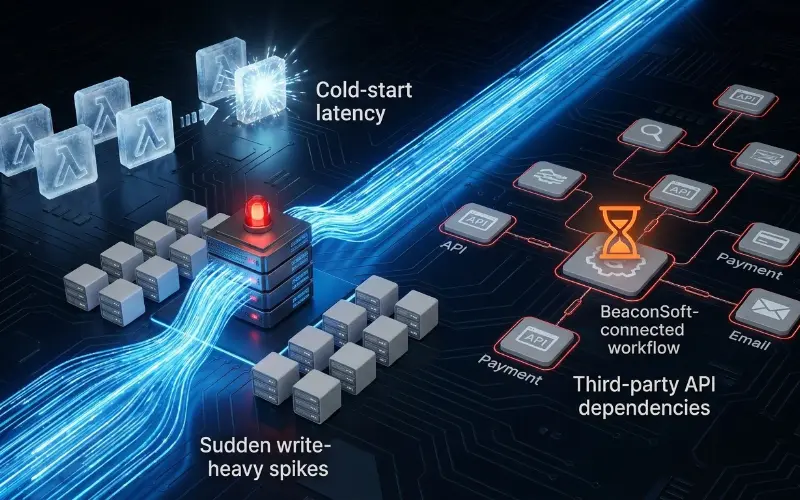
This is the piece missing from nearly every other article on this topic. Real pressure testing exposes three specific failure patterns that don’t show up in a sales pitch.
Sudden write-heavy spikes
A flash sale, a viral post, a bulk data import: these push heavy write operations to the database simultaneously. Autoscaling adds more app servers, but a single primary database still has to process writes sequentially. I’ve watched teams add ten extra compute nodes and see zero improvement because the actual bottleneck was database locking, not CPU.
Third-party API dependencies
If BeaconSoft-connected workflows rely on external services (payment gateways, email providers, CRM sync), the whole chain is only as fast as the slowest link. One slow API call with no timeout configured can hang requests and quietly exhaust your connection pool, even while your own servers show low CPU usage.
Cold-start latency in serverless components
Functions that scale to zero save money, but the first request after idle time pays a latency penalty. Under a sudden burst, dozens of cold starts firing at once can cause a visible lag spike right when users notice it most, during a launch or promotion.
A Quick Way to Sanity-Check Any Platform’s Scalability
Before trusting any vendor’s scalability claims, including BeaconSoft’s, ask for answers to these five things. If a sales team can’t answer them clearly, treat that as a warning sign.
| What to Ask | Why It Matters |
|---|---|
| Max concurrent database connections supported | Reveals the real ceiling, not the marketed one |
| Autoscaling trigger thresholds (CPU %, queue depth) | Shows how fast the system reacts, not just if it reacts |
| Read replica and failover setup | Determines whether one region outage takes the whole app down |
| Rate limits on third-party integrations | Exposes hidden dependency bottlenecks |
| Load test results at 2x and 5x expected peak traffic | Separates real testing from theoretical claims |
Practical Steps to Improve Scaling Regardless of Platform
If you’re already using BeaconSoft-connected tools or evaluating similar business software, these steps matter more than which vendor you pick.
- Separate read and write database traffic using replicas, so reporting queries don’t compete with transactional writes.
- Add circuit breakers around third-party calls so one slow API doesn’t cascade into a full outage.
- Pre-warm serverless functions ahead of known high-traffic events like product launches or sales.
- Set realistic autoscaling thresholds based on actual historical traffic patterns, not default settings.
- Run chaos testing periodically, deliberately killing a service in staging to confirm failure isolation actually works.
I’ve applied this exact checklist while auditing HR and business software rollouts, and it consistently exposes problems that standard load testing tools miss entirely. If your team manages HR platforms at scale, the same scaling logic applies almost identically. Our breakdown of how HRMS Globex handles concurrent employee data requests covers a comparable case.
The Honest Trade-Off Nobody Talks About
Here’s something most coverage of this topic avoids saying outright: better scalability almost always costs more, and not just in server bills. Redundant databases, multi-region failover, and circuit breakers all add engineering complexity. Small teams often over-engineer for scale they’ll never hit, burning budget on infrastructure that a simpler setup would have handled fine for the next two years.
The right question isn’t “does it scale infinitely.” It’s “does it scale enough for what we’ll actually face in the next 12 to 18 months, without locking us into unnecessary cost.” That’s a very different calculation for a 50-person company than for one processing millions of transactions a day.
Where AI Tools Fit Into the Scaling Conversation
A growing number of platforms, BeaconSoft-adjacent ones included, now lean on AI for predictive autoscaling, meaning the system tries to anticipate a traffic spike before it happens rather than reacting after the fact. This works reasonably well for predictable patterns like end-of-month reporting surges, but it’s still unreliable for genuinely unexpected events, like a sudden press mention or a viral social post. If you’re exploring how AI-driven scaling and automation tools fit into a broader tech stack, this overview of AI tools for business growth walks through where these tools genuinely help versus where they’re still catching up.
Cloud Storage and Data Layer Considerations
Scaling under pressure isn’t only about compute and servers. Where and how data is stored plays an equally large role, especially when concurrent read and write operations spike together. Choosing the right storage tier and replication strategy directly affects how gracefully a platform absorbs pressure. For teams evaluating storage architecture as part of a scaling strategy, this guide to cloud storage solutions is a useful reference point.
FAQs
1. Does BeaconSoft’s software work well for small businesses with limited traffic?
Yes. Small and mid-sized workloads rarely stress the system enough to expose the failure points described above, so most small businesses won’t notice scaling issues at all. For readers researching beaconsoft latest tech info, this is generally the least demanding use case.
2. What’s the biggest sign a platform won’t scale well under pressure?
Vague answers about load testing. If a vendor can’t share specific numbers for concurrent users or database connections tested, that’s usually because they haven’t tested it rigorously. This is an important point when evaluating beaconsoft latest tech info.
3. Can autoscaling alone guarantee performance during traffic spikes?
No. Autoscaling adds compute resources, but database bottlenecks, third-party API limits, and cold-start latency in serverless functions often cause slowdowns that extra servers can’t fix. Good beaconsoft latest tech info should account for these limits rather than focusing only on server capacity.
4. How long does it take for autoscaling to respond to a sudden spike?
It varies, but most cloud autoscaling policies take anywhere from 30 seconds to a few minutes to add resources, which means the first wave of a sudden spike often hits before scaling kicks in.
5. Is it worth paying for multi-region failover if my business is small?
Usually not yet. Multi-region setups add real cost and complexity that’s rarely justified until you’re serving users across distinct geographic markets or handling revenue-critical uptime requirements. This distinction is useful when comparing beaconsoft latest tech info with your actual business needs.
6. What’s the difference between vertical and horizontal scaling in this context?
Vertical scaling adds more power to a single server, which has hard limits. Horizontal scaling adds more servers running in parallel, which is what most cloud-native platforms rely on for handling pressure.
7. Does database choice affect how well a platform scales?
Significantly. Relational databases handle complex transactions well but can struggle with massive concurrent writes, while NoSQL options often scale writes more easily but trade off some consistency guarantees.
8. How can I test scalability before committing to a platform long-term?
Run a load test at two to three times your expected peak traffic in a staging environment, and specifically monitor database connection limits and third-party API response times, not just server CPU usage. This provides a more practical way to assess beaconsoft latest tech info.


