



Tech giants envision future beyond smartphones as they build toward a world shaped by AI assistants, smart glasses, and ambient computing that fades into the background of daily life. Apple, Meta, Google, and Neuralink have collectively committed tens of billions of dollars toward this shift, but the honest answer is that smartphones aren’t going anywhere for at least another decade. What’s really changing is which tasks you hand off to a phone versus a wearable, and that split is happening faster than most coverage of this topic admits.
I’ve spent years watching product launches in this space come and go, from Google Glass’s public faceplant to the quiet success of Ray-Ban Meta glasses nobody predicted. The pattern is consistent: hardware announcements get the headlines, but adoption follows a much slower, messier curve than the press releases suggest.
Why This Shift Is Actually Happening Now
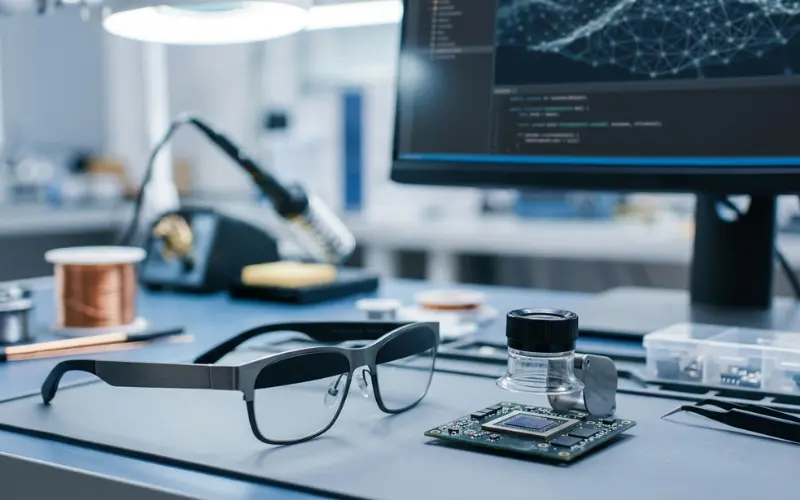
Smartphone innovation has flattened out. Cameras, chips, and displays keep improving on paper, but nobody’s upgrading their phone because of it anymore.
Three things are converging at the same time, and it’s worth understanding each one on its own terms:
- Upgrade cycles have stretched out. People are holding onto phones for three-plus years instead of replacing them every two, which means hardware revenue growth has to come from somewhere new.
- AI models got good enough to run ambient interactions. Voice and context-aware assistants only became usable at scale once large language models could hold a real conversation, not just parse fixed commands.
- Component miniaturization caught up with the ambition. Chips like Qualcomm’s XR-class processors can now fit smartphone-level performance into a pair of glasses that weigh under 50 grams, something that simply wasn’t possible five years ago.
None of this means the phone in your pocket becomes useless. It means specific jobs, checking a notification, getting directions, snapping a quick photo, are migrating to devices that don’t require you to look down.
What Competing Coverage Gets Wrong
Most articles on this topic list the same five companies, quote the same market-size projection, and end with “smartphones will evolve, not disappear.” That’s true, but it’s also not useful on its own. Here’s what actually deserves more attention.
The Real Bottleneck Isn’t Battery Life, It’s Optics
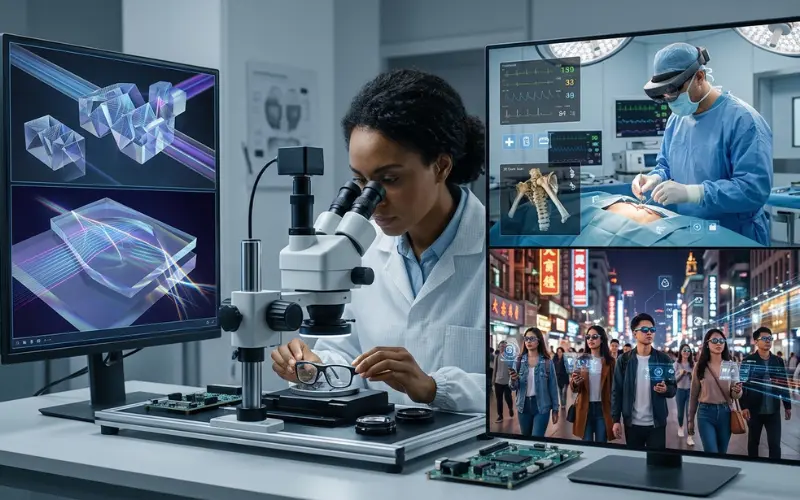
Every article mentions battery life as the top barrier to smart glasses. Fair enough, but the harder engineering problem is waveguide optics, the technology that projects a bright, clear image onto a lens without making the glasses look bulky or the display look washed out in daylight.
Companies can solve battery constraints with bigger cells, software throttling, or offloading processing to a paired phone. Optics is a physics problem. Getting a full-color, wide field-of-view display into a normal-looking lens, at a price under $1,000, is the actual engineering wall the industry is still climbing. This is why most “smart glasses” shipping today (Ray-Ban Meta, for example) skip the display entirely and focus on audio, camera, and AI features instead. The display-equipped version is the harder, later step.
Enterprise Adoption Is Already Ahead of Consumer Adoption
Consumer coverage focuses on whether you’ll personally wear AR glasses to the grocery store. Meanwhile, warehouses, hospitals, and manufacturing floors are already running pilot programs with hands-free AR for picking, remote expert assistance, and surgical overlays.
This matters because enterprise use cases don’t need to solve for style, social acceptance, or all-day battery life the way consumer products do. A warehouse worker’s shift is eight hours with charging breaks built in. A surgeon’s headset only needs to work in a sterile, controlled environment. These lower-friction use cases are quietly proving out the underlying technology years before it’s ready for casual daily wear, and they’re where the near-term revenue is actually coming from.
The Data Ownership Question Nobody’s Answering
If a company selling neural interfaces or always-on smart glasses goes bankrupt, gets acquired, or pivots business models, what happens to the biometric and behavioral data it collected? Current privacy law wasn’t written with continuous eye-tracking, gaze data, or neural signals in mind.
This is a genuinely open legal gap, not a solved problem tech giants have quietly figured out behind the scenes. If you’re evaluating any of these products for yourself or your business, ask the vendor directly what happens to your data if their company changes hands. Most can’t give you a straight answer yet, and that itself tells you something about how early this space really is.
China’s Wearables Market Is Moving Faster Than US Coverage Suggests
Nearly every English-language article on this topic centers Apple, Meta, Google, and Neuralink. Xiaomi, Rokid, and other Chinese manufacturers are shipping AI glasses at price points well under $300, targeting mass-market adoption rather than premium early adopters.
Lower price points mean faster real-world usage data, faster iteration cycles, and a genuine possibility that mainstream smart glasses habits form in Asian markets first, then get copied and refined by Western companies later. This is a well-worn pattern in mobile hardware history, and it’s worth watching closely if you’re trying to predict where this category actually lands.
How the Major Players Compare
| Company | Core Bet | What’s Actually Shipping Today | Realistic Near-Term Use |
|---|---|---|---|
| Meta | Lightweight AI glasses, no display required | Ray-Ban Meta glasses (camera, audio, AI assistant) | Hands-free photos, voice queries, casual AI assistance |
| Apple | Premium spatial computing, ecosystem lock-in | Vision Pro (headset, not glasses) | Productivity, media, professional use, not everyday wear |
| Open AI-first ecosystem across manufacturers | Android XR software, Project Astra demos | Navigation, translation, search integrated with hardware partners | |
| Neuralink | Direct brain-computer interface | Clinical implants for paralysis patients | Medical use only, consumer application is years away |
| Samsung/Xiaomi | Affordable, high-volume wearables | Budget AI glasses and rings under $300 | Mass-market entry point, especially outside the US |
What You Should Actually Expect Over the Next Few Years
Skip the “everything changes” framing. Here’s a grounded, practical read on what shifts and what doesn’t.
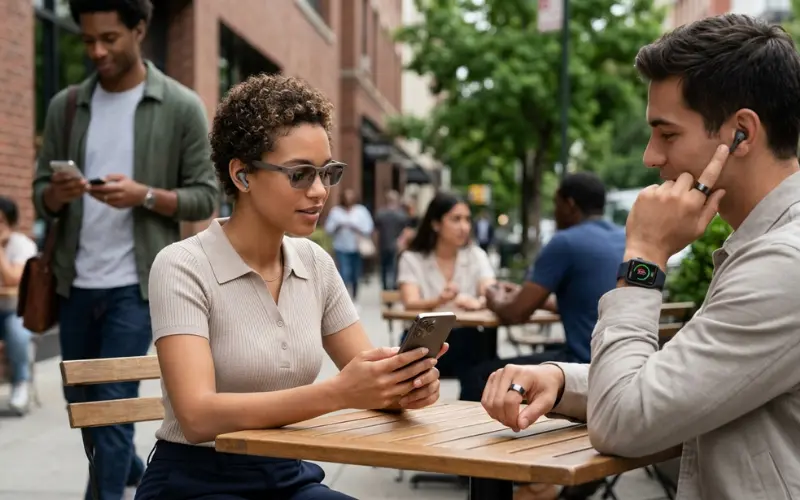
Your phone stays the hub. Processing power, storage, and your primary apps still live on the phone. Glasses and wearables act as satellite devices that borrow the phone’s connection and compute.
Voice and glance replace some taps, not all of them. Quick actions like checking the time, getting a notification, or asking a question move to glasses or earbuds. Anything requiring typing, scrolling, or detailed visual work stays on a screen.
Health wearables lead adoption, not AR. Rings and watches tracking sleep, heart rate, and stress are already mainstream. They’re the quiet, unglamorous front line of the post-smartphone shift, and they’ve faced far less resistance than headsets because they don’t ask you to change how you look or behave in public.
Price will decide the winner, not features. The company that gets a genuinely useful AI glasses product under $300 will likely win more users in three years than the company selling a $3,500 headset with more capability.
Practical Advice If You’re Deciding What to Buy or Build For
If you’re a consumer wondering whether to invest in this category yet, wait for the second generation of any device category before committing serious money. First-gen hardware in this space (original Vision Pro, original Google Glass) consistently gets replaced within 18 to 24 months by a cheaper, lighter, better version.
If you’re a business owner or developer thinking about where to build, enterprise AR and voice-first workflows currently offer clearer ROI than consumer-facing AR apps. The consumer “killer app” for this category hasn’t emerged yet. Enterprise use cases already have measurable productivity gains you can point to in a pitch deck.
If you’re worried about privacy, ask specific questions before buying: does the device process voice and camera data locally or send it to the cloud? Can you physically disable the microphone and camera? What’s the company’s data retention policy if you stop using the product? Reasonable answers to these three questions tell you more than any marketing page will.
Where This Actually Leaves Smartphones
Smartphones aren’t being replaced. They’re being unbundled. Camera duties are splitting off to glasses. Health tracking already left for wearables years ago. Payments moved to watches and rings. What’s left on the phone is everything that needs a real screen: banking, gaming, video editing, long-form reading, and anything requiring precision input.
That’s not a dramatic collapse of the smartphone market. It’s a slow redistribution of specific tasks to more convenient devices, while the phone keeps its job as the processing and connectivity hub underneath all of it. Anyone selling you a “smartphones are dead by 2030” narrative is selling you a headline, not a forecast grounded in how hardware categories actually transition.
For readers tracking the broader hardware landscape, it’s also worth watching how flagship phones themselves are adapting to this pressure. Comparisons like iPhone 17 vs Samsung Galaxy S26 show manufacturers leaning harder into on-device AI precisely because that’s the feature set keeping phones relevant as companion devices for the wearables built around them.
Frequently Asked Questions
1. What device will replace the smartphone?
No single device is positioned to fully replace the smartphone in the next five to ten years. As tech giants envision future beyond smartphones, AI glasses and wearables are taking over specific tasks like notifications, navigation, and health tracking, while phones keep handling processing, storage, and screen-based work.
2. What will be the next big thing after smartphones?
Most industry investment points toward a combination of AI-powered smart glasses, wearable health devices, and ambient computing rather than one single “next big thing.” The idea that tech giants envision future beyond smartphones is increasingly reflected in this distributed approach, where several device categories work together instead of one device replacing the phone outright.
3. What is the next big phone coming out?
Flagship releases continue on their usual annual cycle from Apple, Samsung, and Google, but the more significant hardware news in 2026 is happening in the wearables and AI glasses category. This reflects how tech giants envision future beyond smartphones, with companies investing more heavily in new form factors than in phone redesigns.
4. What did Elon Musk say about phones?
Musk has spoken about Neuralink’s long-term goal of enabling direct brain-to-device communication, framing it as a future step beyond typing and touchscreens. Neuralink’s current work remains focused on medical applications for patients with paralysis, not consumer smartphone replacement.
5. Will smart glasses need a smartphone to work?
Most current smart glasses, including Ray-Ban Meta glasses, pair with a smartphone app for setup and rely on the phone’s data connection for many features. Fully standalone AR glasses that don’t need a paired phone are still in early development, even as tech giants envision future beyond smartphones.
6. Are brain-computer interfaces safe for healthy people to use?
Current brain-computer interfaces like Neuralink’s implants are approved only for people with severe medical conditions such as paralysis, through clinical trials with strict oversight. Elective use by healthy consumers isn’t approved or realistically available, and won’t be for years given the surgical risk involved.
7. How much do AI smart glasses cost right now?
Camera- and audio-equipped smart glasses without a display, like Ray-Ban Meta glasses, generally fall in the $300 to $400 range today. Full display-equipped AR glasses remain more expensive and less refined, with mainstream affordable versions still a few years out.
8. Why did Apple’s Vision Pro struggle to sell well?
Vision Pro’s price, weight, and limited everyday use cases outside of media and productivity work made it a niche product rather than a mass-market device. It’s better understood as a preview of spatial computing technology than a smartphone competitor in its current form.

1 Comment
Pingback: Tech & Battery Safety: Charging Best Practices for Gadgets